Knossos and Phaistos: cameras against fire
The two Minoan archaeological sites are joining the nationwide network of 22 early fire detection systems, on a timetable running through August and September.
English Machine-translated from Greek · Read the Greek original
Greek local news in your inbox, every morning.Subscribe free →
Knossos and Phaistos are being included in the nationwide network of 22 early fire detection systems being deployed at major archaeological sites and monuments across the country, under a specific timetable made known on Thursday 20 August. According to the data published by enikos.gr, eight systems are already in operation, covering Mystras, Epidaurus, Mycenae, Dion, Platamon, Aphaia on Aegina, Peristeria in Messenia and Ancient Olympia. By 31 August 2026 another six are due to be brought into operation, among them Phaistos, along with the Acropolis, the Palace of Nestor, Ancient Messene, Hosios Loukas and Nikopolis in Preveza. A further eight are planned within September, with Knossos first on the list.
The systems combine thermal and optical cameras capable of 360-degree rotation, remotely controlled cameras and a mapping display showing detected outbreaks, the time the alarm was triggered and the status of the equipment. They automatically detect possible outbreaks, trigger alerts and transmit images and data in real time to the Operational Control Centres. The project also includes weather stations, regional and coordinating control centres, and portable firefighting cannons at selected sites. It is being carried out under the AEGIS National Civil Protection Programme, funded by the Recovery and Resilience Facility, while the tender procedure for the supply and installation was run by the Hellenic Corporation of Assets and Participations.
For Heraklion the significance is not confined to the monuments themselves. As the newspaper Patris described in May, the new fire protection regime at the two Minoan sites extends over a wide radius around them, acting as a shield for broader areas as well, while officers of the Heraklion Fire Service had travelled to Athens for specialised training in handling the equipment. Knossos lies at the edge of Heraklion’s urban fabric, while Phaistos stands above the Messara, in an agricultural landscape of olive groves and dry grass. An outbreak detected within the first few minutes in such an environment is a fire that never reached the houses and the crops.
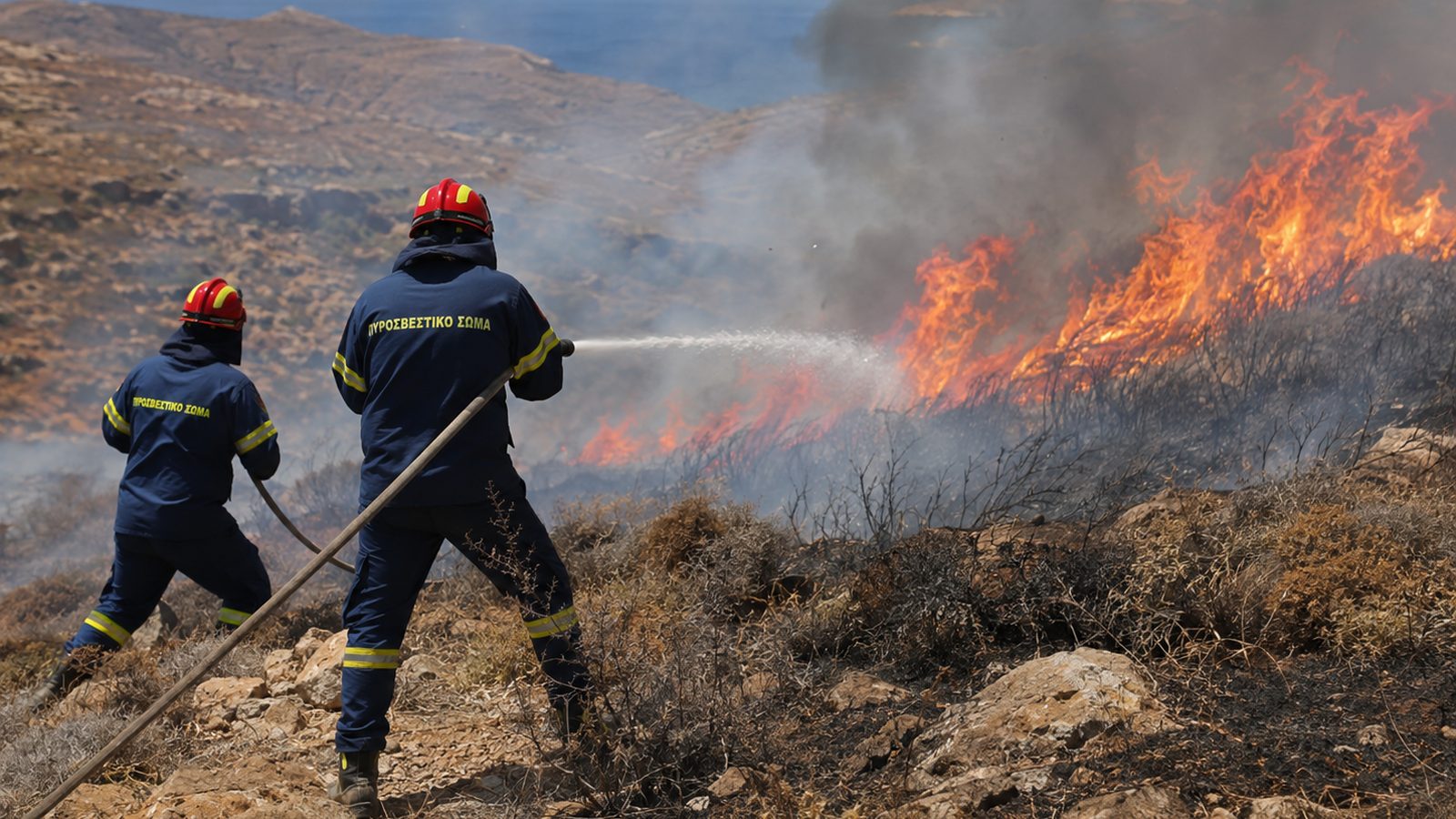
The network’s capability has already been tested in practice: in a fire that broke out on 31 July 2026 at Fichtia in Argolis, within the surveillance range of the Mycenae system, the outbreak was detected automatically and the Coordinating Control Centre immediately received images and data on the incident. The question for Crete is whether the two systems will keep to the timetable, since Phaistos is being installed within the next few days and Knossos in September, that is towards the end of the fire season. It has not been announced how many operators will staff the control centres on the island, nor whether an extension to other Cretan archaeological sites is envisaged. More from the area on the Heraklion page and in the recent report on the dispute over cleaning at Knossos.
Πηγές
Πρωτογενείς πηγές
- Θερμικές κάμερες και εξελιγμένα συστήματα πυρανίχνευσης: Σε Ακρόπολη, Μυστρά και συνολικά 22 αρχαιολογικούς χώρους – Πώς λειτουργούν — ENIKOS · δημοσιεύθηκε 2026-08-20 · ανακτήθηκε 2026-08-20
Μέσα ενημέρωσης
- Νέες τεχνολογίες στη μάχη της πυρόσβεσης – Θερμικές κάμερες σε Κνωσό και Φαιστό — ΠΑΤΡΙΣ · δημοσιεύθηκε 2026-05-05 · ανακτήθηκε 2026-08-20