Piraeus: EVEP guidance on gifts, treats and samples
According to the E.V.E.P. press release, the €10 threshold does not abolish the receipt, and every free distribution of goods needs correct tax classification and documentation.
English Machine-translated from Greek · Read the Greek original
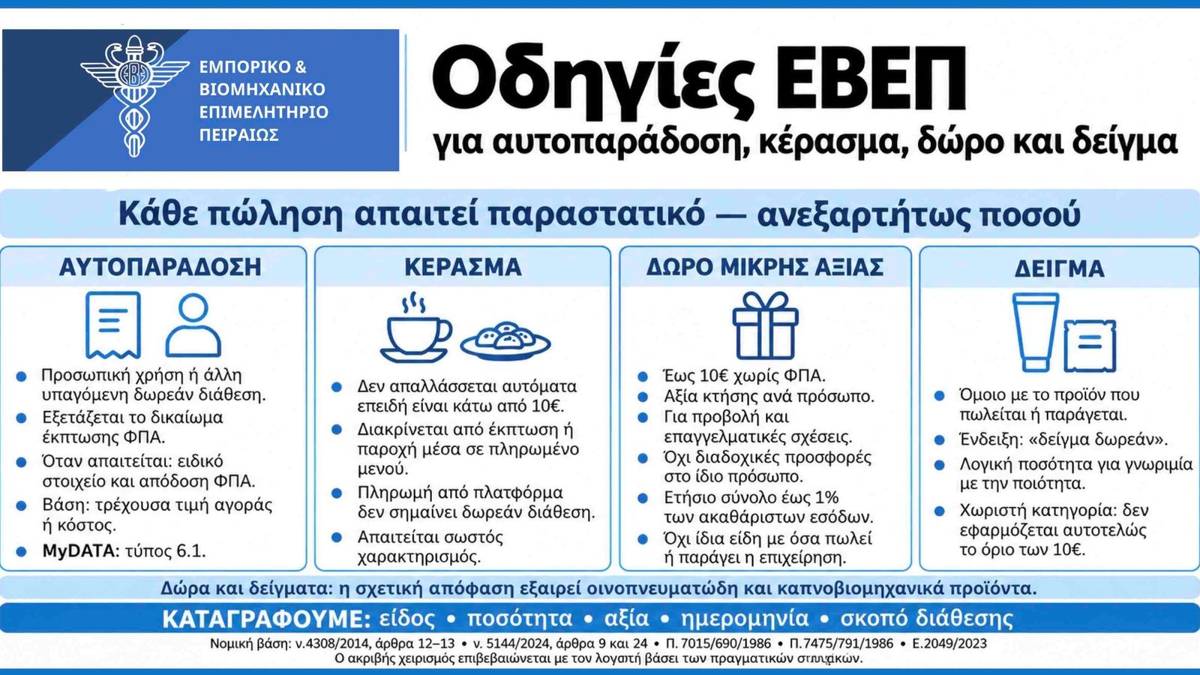
The Piraeus Chamber of Commerce and Industry (E.V.E.P.) issued guidance to businesses on Thursday 29 October 2026 on the tax treatment of free distributions of low-value goods. As the press release states, “self-supply”, “complimentary treats”, “gifts” and “samples” are governed by different rules and require correct classification and documentation, so that errors in tax documents are avoided.
A central point of the announcement is the €10 excluding VAT threshold. According to the Chamber, it applies, under conditions, to specific low-value gifts and is not a general exemption from issuing a receipt or a self-supply document. For an item to count as a low-value gift, according to the release, several conditions must be met cumulatively: it must be offered free of charge to promote the business, the acquisition value per person must not exceed €10, it must not involve successive offers to the same person, the total annual value must not exceed 1% of gross revenue and the item must not be of the same kind as the business’s products.
On “complimentary treats”, E.V.E.P. points out that they are not automatically exempt. In food service, offering free coffee, food or drinks requires separate examination, and it is not enough to label it a “gift under €10”. It must also be distinguished from a genuine commercial discount or from an item included in a paid menu. On sales, the Chamber reminds that every sale needs a tax document and that delivery through a courier or pick-up point does not turn it into self-supply. Samples are, according to the release, a separate category: they concern products similar to those the business sells or produces, are given free in reasonable quantities to get to know and assess quality, and bear the indication “free sample”. The €10 threshold does not apply to them on its own, while alcoholic beverages and tobacco products are excluded.
E.V.E.P. recommends that businesses record the type, quantity, value, date and purpose of every free distribution and keep the relevant supporting documents. The correct classification, the required tax document and transmission to myDATA should, as it suggests, be determined together with their accountant. Documentation, according to the Chamber, protects against unnecessary fines, while it also cites AADE’s explicit note that simply writing “gift” or “treat” is not enough.